On the Hunt
Sometimes being a photographer is predatory. Searching for the right picture or being on the hunt for something to coalesce so that things will be just right can be a large part of what many of us do as photographers. Henri Cartier Bresson would speak about this as choreography, that the photographer needed to be like a dancer moving into position, waiting for the right second, aggressively seeking his/her picture. This was how his phrase, "the decisive moment" coined almost 100 years ago now, came to be.
At 66 my decisive moment pictures might be referred to as "sometime this century" but my relative slowness doesn't mean, however, I am not looking to frame things just so or to find the single instant when things come together to make a wonderful picture. Case in point:
 Many of you know just where this is, at Gay Head (Aquinnah) on Martha's Vineyard. In the picture above I was just cruising, liking the light and the pink and blue color on the deck to the left. But what really caught my eye later was in the next frame:
 Way back there in all that foliage there is something I thought extraordinary. I'll show you with a crop:
 This single tree carving out an existence in this most extreme location, a cliff facing the ocean, battered and hanging on. It is exceptionally beautiful. But I can't use this picture and you probably know why. The crop compromises the quality of the image. (For those of you that don't get what that means it is simple: if you crop out much of the image to "zoom in" on one area, you are throwing away many pixels. Then when you print this now cropped image you are really enlarging the smaller area to make the same size print. You can see this even in the cropped image above, if you look closely. No way is the quality and sharpness going to be the same.)
So, what did I do? I started going back. I tried late morning:
 This was a disaster of large proportions.
I tried in the afternoon:
 This was better, but still pretty flat. Each time I would go I would try everything I could think of in terms of framing:
 I also learned that, if I zoomed in too much with the lens, I would isolate the tree but lose the location that made it special in the first place. There's an important lesson here for all of us: that by isolating the one thing we care about in a picture we may kill it.
Time was running out. I was leaving the island soon, not to return again for weeks. I had a ferry reservation so had get this thing done and done soon. The day I left I packed up early and headed to the Aquinnah cliffs one more time to try it again.
This is the final result, which, as a print, is very wonderful and extremely satisfying for me:
 Too much effort for too little result? Much ado about nothing? Perhaps for you, but not for me as this was what I was hunting for.
Like I said, "on the hunt".


 Sitting there, waiting for the picture to come to me rather than needing to go to it to make it happen, I can remember sitting in this same place with a twin stroke Leica M3 and a 21 mm Summicron lens and 20 exposure Kodak black and white infrared film in the camera, doing exactly the same thing, oh.... 36 years ago. OMG! Long time ago.
 This, of course, is one of the views they want to pose in front of when getting their picture taken, although maybe they wouldn't like the leaning over lighthouse so much. I have always liked to photograph people being photographed, particularly in touristy places.

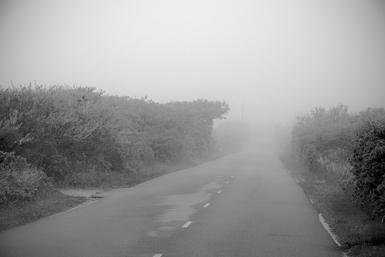


 When both ways of shooting here are considered, the aerials and then these from the ground, do you think this was effort to encompass the landscape I was shooting in a totality of coverage? To get at it in every way from every angle and every manner?
 Not so much. It was an effort on my part to imbue the pictures made of the area with specificity of intent, to work with the location to mold it into what I wanted it to look like. Think for a moment about the staggering limitations of working within the idiom of landscape photography. There is tremendous history, lineage and countless careers built upon it. How does one extend the landscape rendered in photographs, move it and progress it while keeping it recognizable?
 The two above are just focus shift comparisons, perhaps difficult to see on a small display but of large importance when you see the prints which are 22 inches across.


 So, does it work? Have I made pictures that convey something moodier and perhaps darker here, and has that effect been brought to the forefront more due to the aerials provided as a reference? Does this way of working make sense to you? And finally, will I do this in the future: make series pictures in this new comparative way? Can't say for sure, but probably. Wouldn't you?
 This big curve in the road is where the road has come out near the ocean from the interior of the island and parallels the shore. The area I was interested in starts here.
 This is the south facing shore of the island with prevailing winds that are brutal in the winter so nothing can grow very high here.

 Although you can't park anywhere alongside the road and there is no access allowed with no trespassing signs, there are well worn sandy trails from the road down to the beach.
 In the image above you can see the the Moshup Trail road along the top of the frame.
  Okay, so that gives you the way the area looks. I made these pictures before I started making the pictures from the same area on the ground.
 This plaque sits along the Moshup Trail road at the curve. Here's a blow up of the plaque:
 This simply states that the area is preserved as conservation lands, meaning nothing can be built on it.
 Hopefully I've set this up to show you how the area looks from above as a kind of survey or a map. In the next post I will show you work I made when photographing along the same stretch of maybe a couple of miles of road while on the ground.